
Would you watch or play a sport with no tension? No risk of injury? No way to attain excellence? Well, the South Park episode of Sarcastaball explores this idea. There, the children of South Park have to play a sport that cannot potentially harm them. No injury in Sarcastaball, no pain. Byung-Chul Han would see this sport as a monstrosity. In The Palliative Society, Han argues that nowadays, we are no longer able to endure any pain.
Sarcastaball
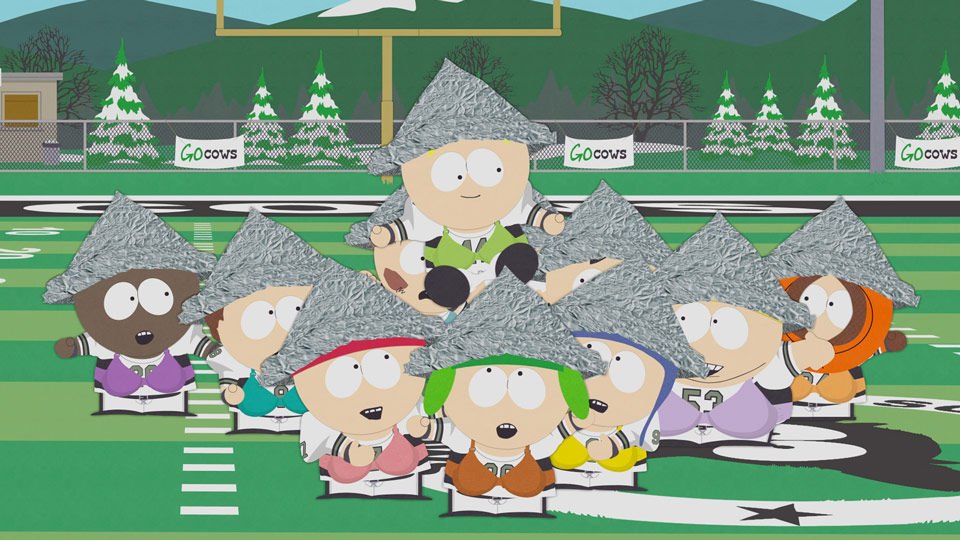
Sarcastaball is a classic South Park episode. In it, there is an ongoing discussion about concussions in American football. Many professional athletes seem to have brain damage because of playing the sport. Therefore, to make the game safer, the school where the South Park children attend restricts certain plays or actions that can be performed. Enter Randy Marsh. Furious about the new restrictions, he sarcastically proposes a sport so safe it’s ridiculous: everyone wears bras, the ball is replaced by a balloon, and instead of tackling, players simply hug. He calls it Sarcastaball. Immediately, it’s a huge hit and soon takes the world by storm, because everyone sarcastically thinks it’s the best idea ever, a sport with no danger or pain.
Obviously, Sarcastaball, if played in the real world, would be a very dull sport. An aspect of a sport that is entertaining is that it is dynamic and, in some sense, risky. There’s no thrill without danger. Being a highly skilled athlete does not necessarily mean being a healthy person. Sport rewards excellence, but excelling in one area often means sacrificing excellence in others, sometimes even harming oneself in specific ways.
Algofobia

Byung-Chul Han argues in The Palliative Society that today, society suffers from algophobia, a fear of pain. Our society is fixated on soothing, numbing, and cushioning every aspect of life. Every unpleasant feeling must be treated, managed, or eliminated. Pain is deemed to have no right to exist. We constantly take pills to numb headaches. Feeling stressed? Try Buddhist Mindfulness! And don’t be sad! Visit a therapist! These are all examples of numbing pain, under the mistaken belief that this will lead to greater happiness. However, Han suggests that this does not increase happiness but actually diminishes it. A life without pain is a meaningless life. When the children in South Park play Sarcastaball, they are not happy playing it. They don’t feel pain, but they aren’t happy either. Winning doesn’t mean anything to them.
Nietzsche believed there is a close connection between pain and pleasure. The deepest pain can lead to the greatest happiness. To understand this, we need to clarify what Nietzsche (and Han) meant by pain. According to Nietzsche, pain arises where there is resistance. It’s the tension we experience when the world pushes against our will. This resistance is what gives our actions depth. There are two ways to respond: either we overcome it or we deny it. Imagine running. The first time you run, two kilometres might already feel difficult. Your legs will ache. Pain everywhere. Pure hatred for running (trust me, I have experienced this). However, if you keep running regularly, you could eventually run ten kilometres. Two kilometres then won’t cause pain anymore. Denying the resistance is simpler. The first time you run, you cover two kilometres and your legs hurt. You might think it’s not worth it and stop (as I have done many times). As a result, you won’t experience pain anymore. Sarcastaball is a sport that chooses denial. It removes any resistance from the game. No risk, no struggle, no growth. The only “skill” left is being sarcastic enough to pretend it’s meaningful.
What goes around, comes around
Han highlights two ways avoiding pain has a perverse effect. First, a taboo develops around pain. If pain is considered bad, then feeling pain means something bad has happened. As a result, showing pain becomes negative in itself because it suggests you have done something wrong. The outcome is that everyone acts as if they are pain-free. On Instagram, we see perfect lives without any pain. This creates unrealistic standards because, as the second perverse effect reveals, pain is unavoidable. Not only is pain the most certain experience, but trying to reduce it as much as we do makes us quickly irritable. By trying to eliminate pain, we make ourselves fragile. Our threshold for pain is so low that almost everything seems to hurt. Like stepping on a Lego (kidding, that’s the most ultimate agonising pain there is).
Han compares us to the princess in the old fairy tale, who could feel a single pea under twenty mattresses. The girl’s hypersensitivity was proof of her royal blood. Today, it’s proof of our collective fragility. The slightest criticism, the tiniest frustration, feels unbearable. The more we try to escape pain, the more it becomes intolerable.
Han seems to echo the typical grandfather saying that nowadays, young people cannot handle anything anymore. Although I believe this is an exaggeration, there is some truth to it. Think about the ‘safe spaces’ in American colleges where people are protected from hurtful opinions. This is contrary to the university’s purpose, which requires confronting students with potentially uncomfortable truths. A criticism quickly turns into a personal attack. Even if in last place, some still need a participation trophy.

“Whatever does not kill me makes me stronger.” These words by Nietzsche embody the idea that pain can be a creative force. Too much resistance becomes unbearable and ultimately destroys you, but too little makes life dull and leaves you weak. If you never find yourself in the uncomfortable position of asking someone out on a date, you might never meet the love of your life. If our tolerance for pain is low, then our creative potential will also be limited. Without challenge, there is no excellence. Many artists have achieved great things which they attribute to their suffering. For them, it is because they suffered that they have accomplished remarkable work. Indeed, if we see pain as the sensation caused by resistance, then the greater the resistance, the more pain we will endure. However, overcoming greater resistance also results in a stronger creative force.
The Lost Meaning of Pain
So, why can we no longer endure pain? Han’s answer is bleak; pain no longer means anything. In earlier ages, pain had a place in a larger story. For Christians, for example, pain is not necessarily a bad thing because it could bring them closer to heaven. Pain, for communists, is not a bad thing because it could bring them closer to their ultimate community. But nowadays, we don’t seem to have such a story. We’re all individualistic people, but individual people avoid pain because it is unpleasant.
Another reason could be that we view pleasure as the highest good to pursue. Happiness is associated with experiencing pleasure, a particular chemical that flows through our brain. This contrasts with how ancient philosophers, such as Aristotle, understood happiness. For Aristotle, happiness was a form of flourishing where a person becomes a better human being. This did not necessarily involve pleasure, although it would ultimately lead to it. One reason for this view could be utilitarianism. Utilitarianism holds that pleasure is the highest good and that we should maximise it in the world. It is very popular today, especially with movements like effective altruism. Utilitarianism attracts people because of its simplicity. The goal is to increase happiness, either by enhancing pleasurable feelings or by reducing pain, which is seen as the opposite of pleasure. The second approach presents a problem. The easy way to reduce pain is to numb it with external means. Overcoming pain is uncertain and very difficult. Therefore, it is simpler (and arguably more ethical under utilitarianism) to lessen pain through external measures such as pills or other methods.
Erich Fromm argued that our society has increasingly shifted from creating to consuming. We habitually think about having rather than being. Combining this with Han’s perspective, we might say that we have been misled into believing that consumption leads to happiness. If you are unhappy, you might take pills, visit a therapist, do some yoga, or seek more money. However, the creative force within us is missing. We possess quite a lot, yet we feel insignificant. This results in a kind of emptiness. We keep working, but we see little real progress in our lives, apart from promotions and higher salaries, which tell us nothing about our human essence. Fromm would say that the rise in depression is a consequence of this social trend.
Overprotection and Antifragility
When we try to protect our children too much, they will not be prepared for the real world. The world is a tough place, where suffering is unavoidable. Even in societies with excellent healthcare, you will inevitably grow old, and the ageing process can be painful. Preparing children for this reality is essential, and it is the responsibility of both parents and schools. Failure to do so will have serious consequences.
South Park’s Sarcastaball episode, then, is a reflection of what is happening in society. A good comic will confront us with uncomfortable truths, but through laughter, they make it more bearable

Nassim Nicholas Taleb discussed the idea of antifragility. Fragile objects are those that can be broken by resistance, pain, or conflict. Antifragile objects, on the other hand, get better because of these challenges. Taleb emphasises that this is different from resilience. Resilience means remaining the same despite facing resistance, whereas antifragility becomes stronger through overcoming it. Resistance is often necessary for things to operate smoothly. For example, flying an aeroplane has become so straightforward that pilots are no longer attentive, trusting the system, and therefore not prepared for potential dangers. Making the process slightly more challenging could actually save lives.
No one likes pain, unless you’re a masochist. But disliking pain is not the same as denying its value. Pain teaches. Pain reveals. Pain transforms. Pain helps us understand ourselves in many ways. It can aid us in improving our lives. It can make us strong, resilient and dependable. Too much pain will ultimately kill you, but completely removing pain ensures you never truly live. Pain is unavoidable, but it can be harnessed for good. Sarcastaball only guarantees we remain in the same place. The true hero in every story uses their pain to overcome great obstacles and to move forward. Pain, therefore, might also be a call towards adventure. So perhaps the question isn’t how to avoid pain, but how to endure it well, to turn it into strength, beauty, and wisdom. That, perhaps, is what it truly means to play the game of life.



 Elenchus Philosophy
Leave a comment