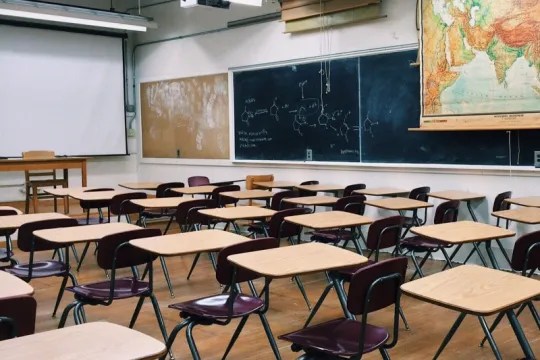
The function of education has always been a heated debate. Why do we go to school? Nowadays, it is to get a well-paying job. However, it used to be different. School was a place for personal growth. Although this conception of education still remains alive, it has been pushed to the back in favour of economic reasoning.
A Reversal in Education
The university has undergone a significant shift. My parents’ generation was determined that their child would go to higher education. We had to do well in school because that would be our ticket to prosperity. A university degree was a guarantee of a better life — at least financially. Of course, that is no longer true today. A university degree is no longer a guarantee of a well-paid job. The only advantage we have is that those without a degree have even fewer opportunities.
This idea is logical, since throughout history only the wealthy could afford to pursue university disciplines. Every philosopher in history was, in one way or another, a wealthy person who (because he had substantial resources or others who worked for him) could afford to reflect on the mysteries of life. For the ancient thinkers, a school was literally a place where one could spend leisure time. Work was a sign of necessity and, by extension, of poverty. A truly wealthy person devoted himself to philosophy, art, and science, not work.
Today, we see a complete reversal. Where once the highest disciplines were those that fostered personal growth, today they are the disciplines that generate the most material wealth. A degree has become a stepping stone to riches. One no longer studies to elevate oneself, but to acquire wealth later on. One of the main reasons is, of course, that we need to work to survive. In this society, we have to earn money by working, because otherwise we would not be able to support ourselves. The rich had enough money to support themselves, and thus had the material freedom to pursue subjects that were not financially profitable. However, there are several other reasons for this shift as well.
In the past, education was a private matter. One spent one’s own money to hire a teacher who could educate the youth. The only accountability for the choice of subjects was to oneself. Nor was the intention that this would lead to greater material wealth. Today, education is a public matter, largely funded by the state. In return, there is a certain duty to contribute to society. What you study must, to some extent, serve society. The “useless” disciplines, such as philosophy, are still offered because we feel they are somehow necessary. But if we look at where the money flows, it is certainly not toward the humanities. And logically so. These disciplines do not generate profit. They only cost money. When cuts need to be made, it is therefore logical (from an economic perspective) to cut them first. Cutting profitable disciplines would lead to less profit. In philosophy, that is certainly not the case. Philosophy does not solve problems; it creates them.
In the United States, the cost of a degree is a much bigger problem than in Belgium. A university education there costs an immense amount of money, yet a degree in the humanities does not provide many additional job opportunities. As a result, one may hold a degree in philosophy but have no means to repay the debts. Staff for the various non-profit disciplines also costs enormous amounts of money. Budget cuts once again result in positions not being filled, which at some universities leads to philosophy being removed from the curriculum or no longer being taught by professors but by general lecturers.
This evolution stems from a dominant idea in education: that education is a stepping stone to the job market. Education must train us to function within the machinery of the labour market. The more and the faster it can deliver this, the better. When you attend a university fair and visit the different booths, they have a list of possible careers linked to each degree ready. Nowhere did I encounter anyone speaking about my personal elevation. When I went to the philosophy department, I was promptly told that I could easily work for a bank. As if that were the reason to study philosophy.
I have nothing against choosing a particular field in order to obtain a well-paid job. If that is what you want to do with your life, that is your choice. But that is different from claiming that the entire school system must serve that function. I disagree. I believe this has many negative consequences on society at large, not least the lack of critical thinking.
In a sense, it is as Erich Fromm describes in Escape from Freedom. When teacher and student stand in relation to one another, that relationship is based on reciprocity. The teacher’s and the student’s interests coincide. If the pupil fails, the teacher fails as well. With the slave and the slaveholder, it is different. The slaveholder is concerned only with how much benefit he can extract from the slave. Superiority has a different function in each case. In the first situation, superiority is a condition for growth. In the second, it is a condition for exploitation. I believe the school system now leans more towards the second.
Moral Development
Erich Fromm already criticised this in the twentieth century. The mindset of contemporary education is one of having. We want to earn a degree and make a lot of money to buy beautiful things. It is a way of thinking rooted in consumption and production. Fromm argues that we are no longer concerned with being. That means becoming a fully realised human being. Education was originally meant to serve that second function. Without education, you cannot become a fully realised person. You remain a limited creature driven by irrational impulses. You cannot function in a fully human way. It is no wonder that many students simply wait until they can leave school, even though it ultimately serves their own good. The negative consequences are, of course, the inability of individuals to critically engage with the world. For large corporations and political institutions, this is obviously a good thing. That way, the common people are more easily controlled.
The ideal of Bildung, put forward in eighteenth- and nineteenth-century Germany by thinkers such as Schiller and Humboldt, is rooted in the Greek concept of paideia, meaning education or formation. There are many interpretations of this ideal, but its core idea is the moral development of the child. According to Kant, the human being is the only animal that must be educated. Education naturally has a goal. One must be formed according to a certain ideal image (Bild). For many philosophers, this ideal image is the rational human being. School is the appropriate place for learning this. Education must teach children to become responsible and moral human beings. If it does not, society is doomed to fail. Educated and formed children will be able to engage critically with media and AI, will not be seduced by the allure of extremist organisations, and will treat others with respect. Are these not precisely the shortcomings so often attributed to youth today?
A contemporary Dutch philosopher who wrote about Bildung as an ideal a few years ago is Joep Dohmen in his book Iemand Zijn (Being Someone). There, he explains that the humanities are of utmost importance. Following Foucault, Dohmen assumes that the “self” must be shaped and constituted. We are not simply someone; we must make ourselves into someone. Parents alone cannot be held responsible for a child’s development. Society as a whole bears responsibility. But it begins, in fact, with the school system. The school system should form children into moral beings before they even take up a job.
Courses in worldview and ethics are fundamental to a child’s development. They teach children openness to different perspectives and give them sensitivity to moral problems. It is therefore miserable that these subjects are in fact being eliminated in the name of financial cuts. There is, of course, a vicious circle at play. Because the humanities are not considered important (since they are not economically profitable), teachers will also feel less motivated to invest in them. Students begin to see the subjects as less important, which in turn produces teachers who put little effort into their teaching (and they certainly exist). As a result, the subject further acquires the reputation of being unimportant.
The Need for Revaluation
Today, there is an urgent need for such a revaluation. Students are far less interested in a job that simply pays them a lot of money. They are primarily focused on personal growth in their work. But why, then, do we still behave in school as if the job were the finish line? Personal growth begins at birth and ends at death.
A major problem, which I have written about before, is the phenomenon of bullshit jobs. Work is no longer the engine of personal growth. Many jobs are completely soul-crushing and pointless. That is why schools must move away from the idea that they should prepare children for a job and return to the ideal of formation. This would benefit not only the individual, who would be far better equipped to shape their own life, but also society, because it would counteract extreme forces.
Become who you are. It was one of Nietzsche’s main aphorisms. For Nietzsche, this meant that people need to grow into themselves. They have a certain potential for good and growth. Schools should be places where that potential gets the chance to grow and develop. Nowadays, I fear that this is not happening. Or at least, too little. However, hope is never lost. Education also happens outside of school, and maybe by arguing for moral education, we can make the revaluation real.



 Elenchus Philosophy
Leave a comment